Smart Specialization Strategy is the development strategy of the EU member states or its regions, which focuses on exploiting the results of Research, Technological Development and Innovation (RTDI) from the productive sectors in which the country/region has, or can acquire, a competitive advantage.
Given the interrelationship between the various sectors, in the new programming period, smart specialization is focused on those activities of the sectors that, using the knowledge of the business and research world, can produce competitive products of high added value, capable of being integrated into international value chains.
The philosophy of the Smart Specialization Strategy is to integrate the results of research and innovation in the productive sectors in which a region already has a competitive advantage, or in new sectors in which it can acquire, in order to achieve its sustainable development.
It relies on cooperation among all stakeholders who create added value in the economy, as expressed by the quadruple helix: local government bodies, businesses, research organisations (academic institutions or research centres), and civil society.
Quadruple Helix is the term used in the context of the Smart Specialization Strategy to indicate the four categories into which the participants (stakeholders) fall in the innovation system of each region. These categories are:
- Research Community (Academic institutions, Research centers, etc.)
- Businesses
- Public sector (municipal and regional government)
- Civil Society
Each of these is expressed and supported in the Smart Specialization governance system.
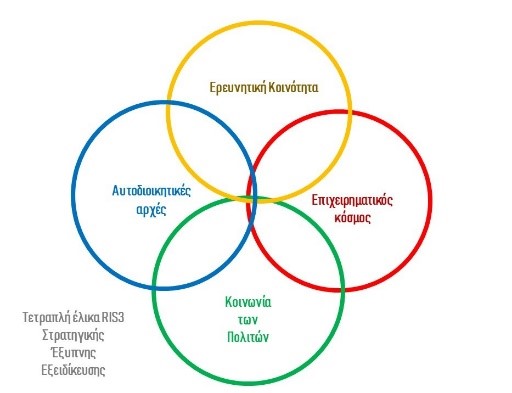
In the Region of Western Macedonia, the Smart Specialisation governance system brings together everyone involved in designing, implementing and monitoring the strategy: the participants in the quadruple helix of the innovation system, the RIS Structure of the Regional Development Fund of Western Macedonia, the Regional Research and Innovation Council (PSEK), the Managing Authority of the Western Macedonia Operational Programme, and, in a strategic role, the Regional Council and the Regional Governor of Western Macedonia.
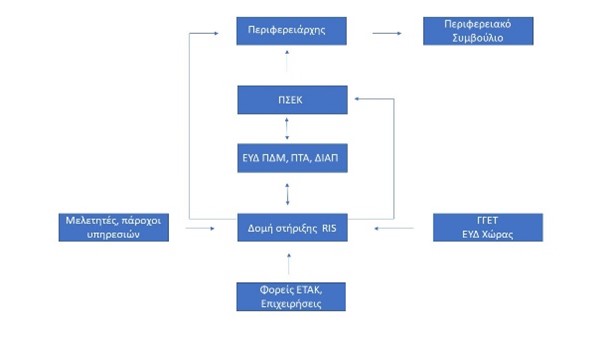
Source: RIS Monitoring report 2019
The Regional Research and Innovation Council (PSEK) was established as part of implementing the Smart Specialisation Strategy in each region, to support development actions in research, technological development and innovation (RTDI).
In the Region of Western Macedonia it consists of 11 members, of which 6 are professors of A.E.I. and researchers of research centers supervised by the Minister of Education, Research and Religious Affairs and 5 come from professional chambers and scientific associations, cultural bodies, the local government and the productive bodies of the region.
The innovation ecosystem is the result of the cooperation of three factors:
- of research organizations,
- of industrial enterprises and
- of start-ups.
In the Region of Western Macedonia, the core of the structures – research, technological development and innovation (RTDI) bodies are the following:
- University of Western Macedonia (which has been merged with TEI of Western Macedonia),
- CPERI — Chemical Process and Energy Resources Institute (CERTH),
Other bodies of research, technological development and innovation (RTDI) are:
- DIADYMA S.A. — Waste Management of Western Macedonia S.A.,
- KEPE – Center for the Environment,
- E.A.G.M.E. & PPC SA
More broadly, the following deal with RTDI and entrepreneurship issues:
- Technical Chamber of Greece — Western Macedonia Section
- Economic Chamber of Greece — Western Macedonia Section
- Geotechnical Chamber of Greece — Western Macedonia Section
- Kozani Chamber of Commerce and Industry
- Grevena Chamber of Commerce and Industry
- Kastoria Chamber of Commerce and Industry
- Florina Chamber of Commerce and Industry
- Western Macedonia Regional Development Fund (RDF)
- Enterprise Europe Network – Hellas (Euro Info Centre)
- AN.KO. S.A
- AN. KAS. S.A.
- Kozani Municipality Development
- Clube (Cluster of Bio-economy and environment of Western Macedonia)
- EYDEP PDM
- DIAP PDM
- Western Macedonia RIS/RDF Support Structure
The following four (4) priority sectors were included in the Smart Specialisation Strategy RIS3 (2014-2020) of the Region of Western Macedonia:
- Agri-food
· Processing and standardisation of distinctive agricultural products
· Food, drinks
- Environment
· Energy/RES-District heating
· Integrated Waste Management
· Metal structures
- Breeding of fur animals – leather products
- Tourism